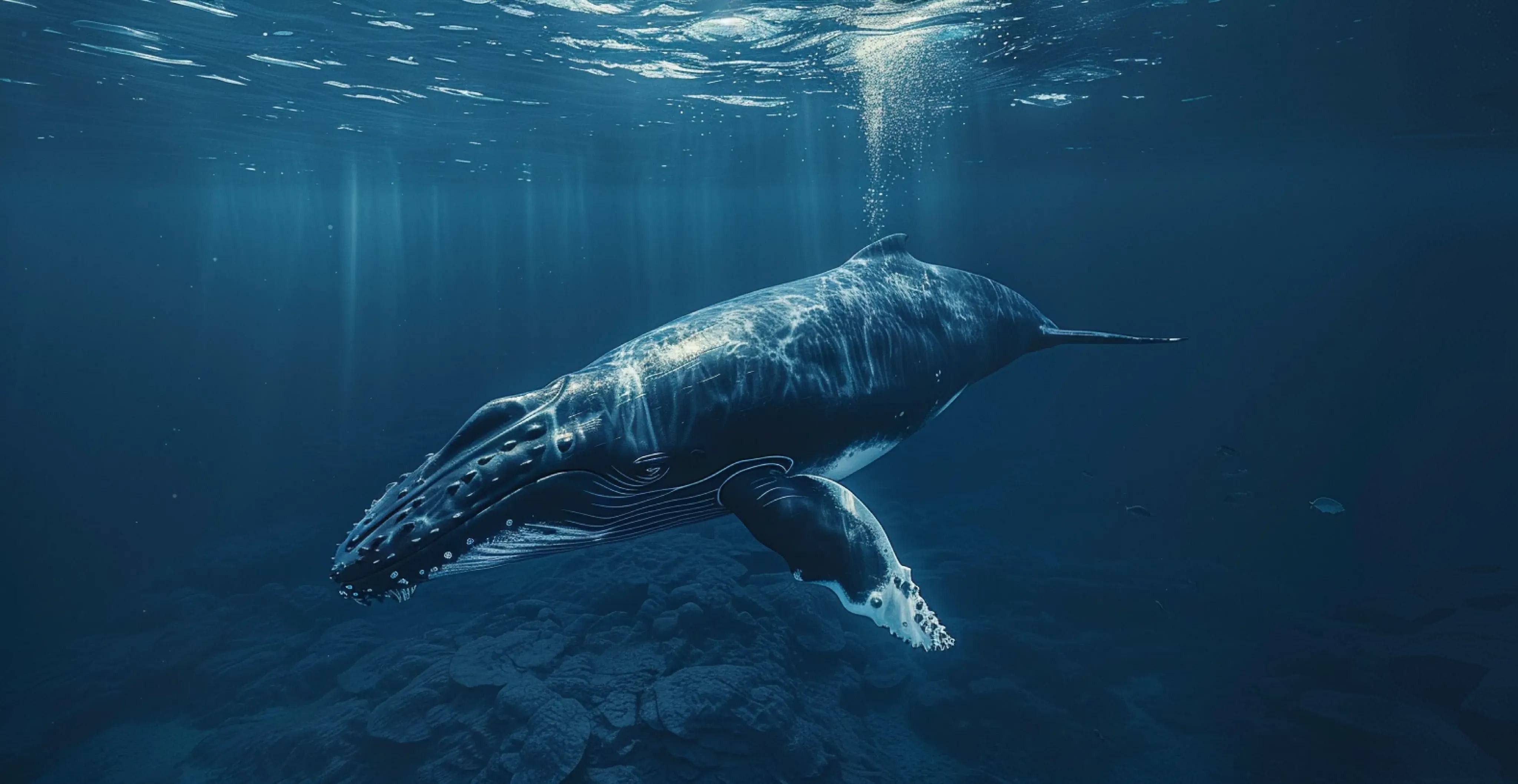
General information
Client: Petrobras
Date: May 2024
Duration: 2 years
Tags: offshore, marine bioacoustics, cetaceans, DAS, R&D




Cetacean Monitoring with Distributed Fibre Optic Sensing
Traditional acoustic monitoring faces well-known limits offshore: hydrophones and fixed sensor arrays are costly to install and maintain, cover a restricted area and demand complex logistics in deep water. Scaling up data collection without multiplying that infrastructure is one of the main bottlenecks in marine bioacoustics today — especially along a coastline as long and biodiverse as Brazil's, where nine of the fifteen whale species catalogued worldwide have already been recorded.
How DAS technology and artificial intelligence are reshaping marine bioacoustics.
Petrobras carries out continuous monitoring of marine species populations across its operating areas, seeking to understand and mitigate any environmental impact of its activities. As part of that commitment, the company is one of the largest sponsors of marine biodiversity protection programmes in Brazil. One of the main focuses of this effort is the underwater acoustic environment: cetaceans — whales and dolphins — depend on sound to communicate, navigate and breed, which makes them particularly sensitive to noise of human origin, such as that generated by seismic survey campaigns.
To track that impact, Petrobras works with Instituto Aqualie, one of the world's leading authorities in marine bioacoustics and responsible for one of the longest-running passive acoustic monitoring programmes in the South Atlantic. The Institute combines different technologies — hydrophones, acoustic tags, visual sightings and population tracking — to map the presence, behaviour and seasonal distribution of cetaceans along the Brazilian coast.
Since 2024, Instituto Aqualie has contracted Immer Messen to develop an approach that is the first of its kind in Brazil: turning submarine telecom cables already installed by Petrobras into continuous acoustic sensors, through Distributed Fibre Optic Sensing (DFOS) technology, specifically in its DAS (Distributed Acoustic Sensing) mode.
The principle is straightforward: idle optical fibres inside a telecom cable — ones that carry no data traffic — can be interrogated by equipment installed onshore, capable of detecting nanoscale strain along the entire length of the cable. Every metre of fibre effectively becomes a listening point. No physical intervention in the existing subsea infrastructure is required.
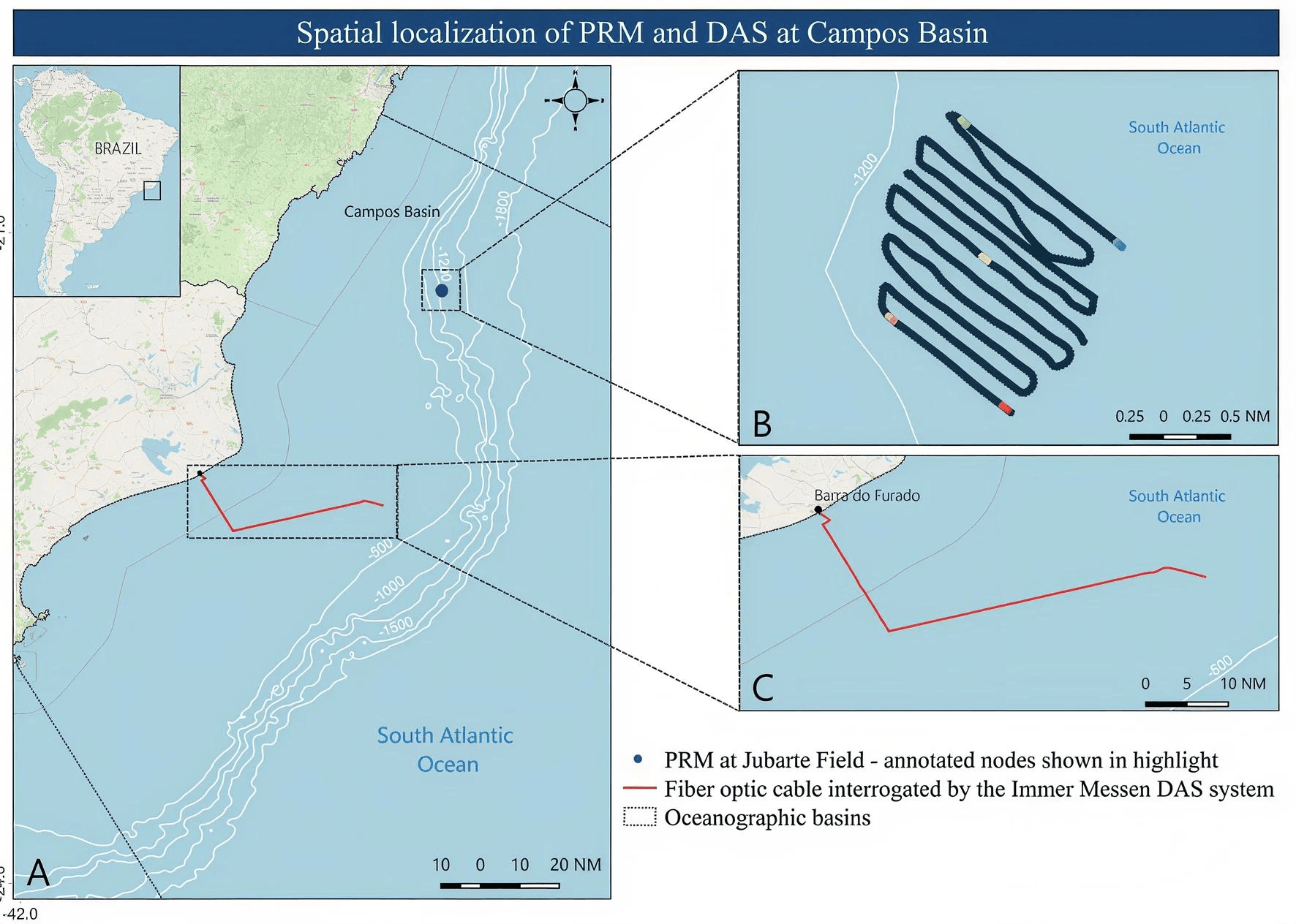
The project also draws, in a complementary way, on historical Permanent Reservoir Monitoring (PRM) data — seismic sensors originally installed by Petrobras at the Jubarte Field for reservoir monitoring — repurposed by Instituto Aqualie to confirm the seasonal occurrence of humpback, fin and sei whales in the Campos Basin.
After a laboratory testing phase in 2024 — which validated the system's sensitivity to low-frequency sound and calibrated parameters such as cable tension and gauge length — Immer Messen installed its interrogation system at a telecom station in Barra do Furado (RJ), monitoring a submarine cable more than 110 km long in the Campos Basin.
The volume of data generated by a DAS system operating continuously over a hundred kilometres of cable is on the order of tens of terabytes per campaign — impossible to inspect manually. To handle that scale, Immer Messen has been developing, since 2020, its own automatic anomaly detection algorithm, based on analysing the power spectral density (PSD) of the signal at each point of the cable across defined time windows. The algorithm sweeps the dataset in space and time, identifying abrupt energy variations in specific frequency bands and generating a catalogue of events — each associated with a position, time and spectral signature — later validated by specialists at Instituto Aqualie.
This layer of artificial intelligence is what makes the system operationally viable: it lets biologists at Instituto Aqualie, from their headquarters in Juiz de Fora, Minas Gerais, remotely track the presence of whales around the Petrobras telecom cables — with no need for vessels, field teams or travel to the coast.
today, monitoring works in real time
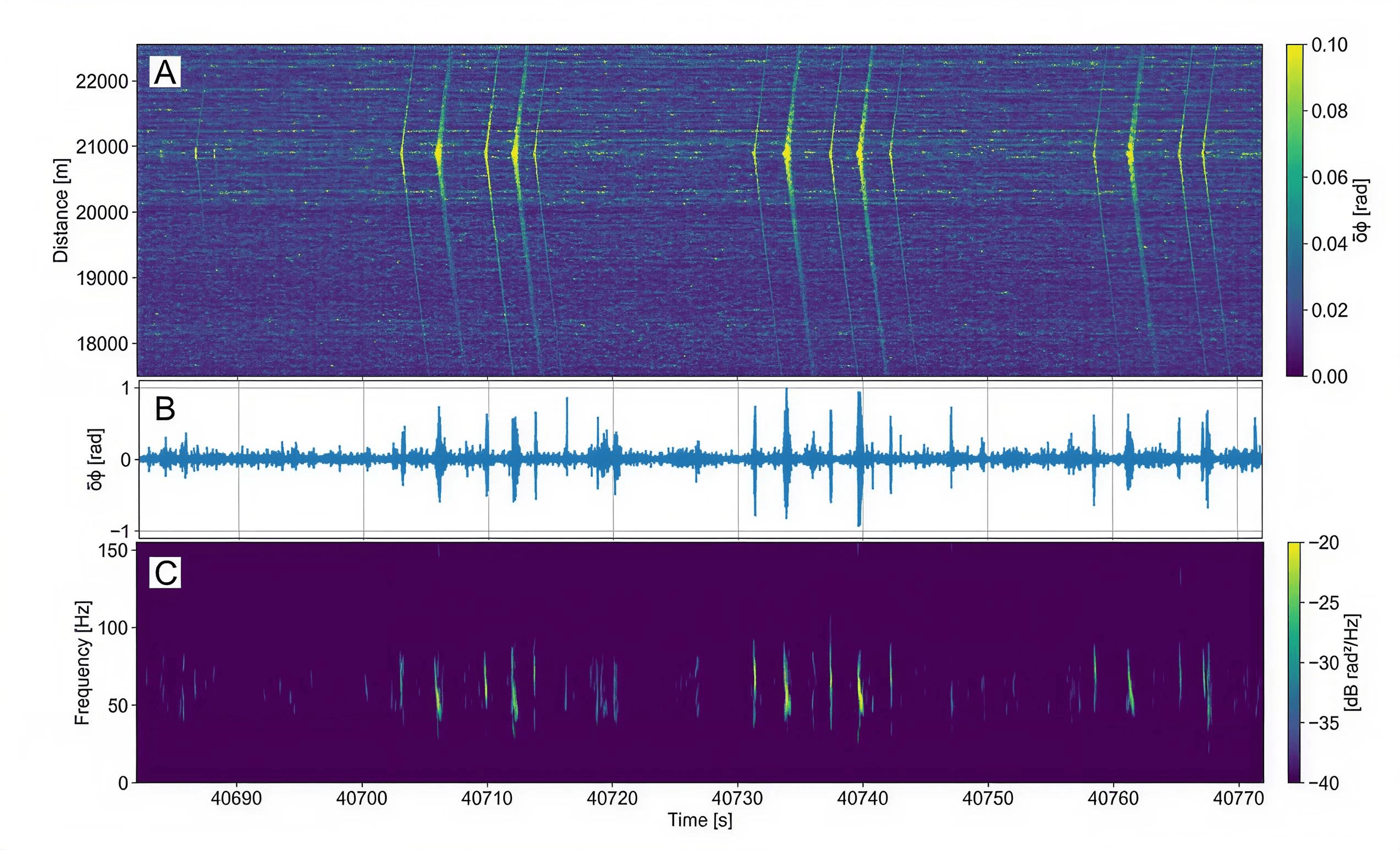
The field campaigns confirmed the viability of the technology for bioacoustics at real scale. In a measurement taken about 21 km from the coast, the system identified 17 distinct vocalisations within a window of only 90 seconds, with spectral patterns in the 40 to 120 Hz range — consistent with fin whale vocalisations. The signals appear in the data as characteristic "V"-shaped patterns, a result of the acoustic wave propagating along the cable, which makes it possible not only to detect the sound but also to locate its origin to within a few metres.
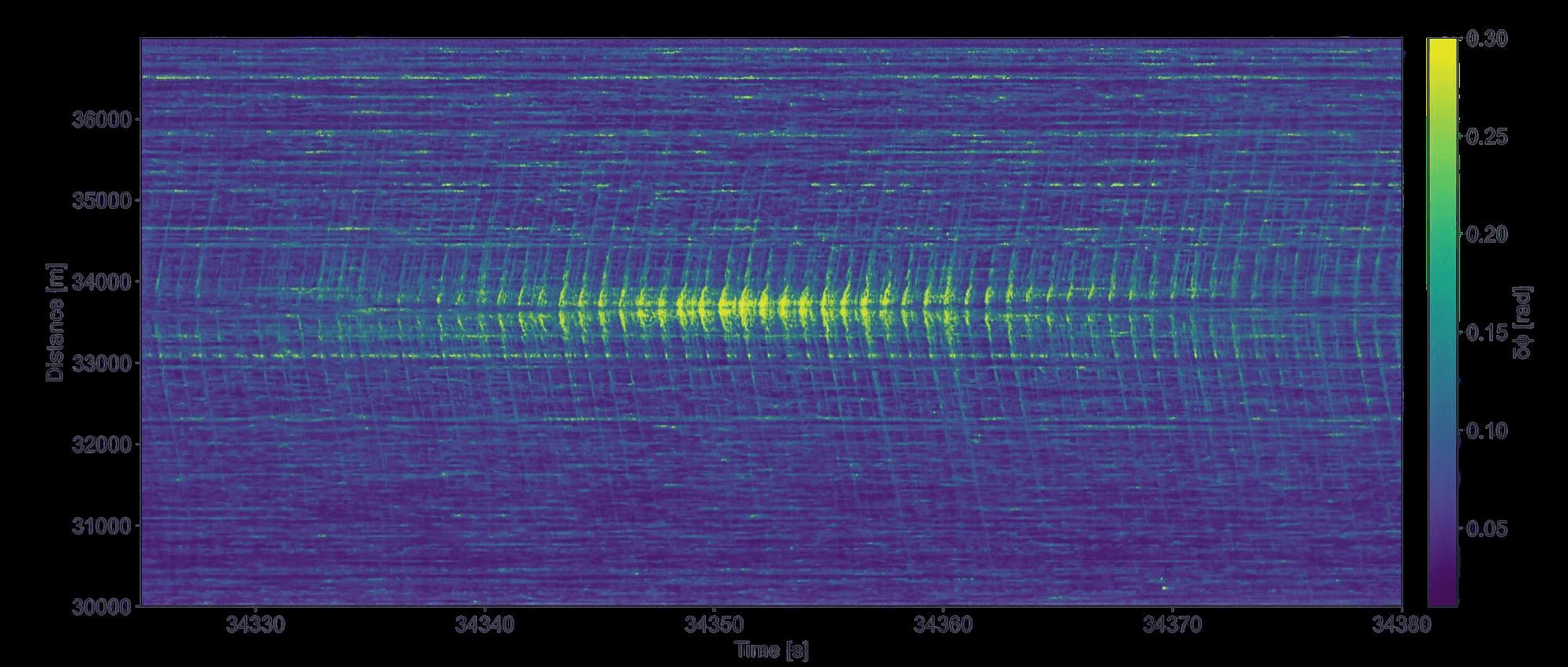
The same infrastructure and the same detection pipeline proved sensitive to other classes of signal relevant to offshore operations. In the 30 to 37 km stretch (about 33.5 km from the coast), the system recorded sequential hyperbolic patterns characteristic of vessel noise. The attenuation observed near the apex of each pattern relates to the geometry between the vessel's movement and the cable: intensity rises as the vessel approaches the fibre and falls as it moves away. The temporal evolution of these arrivals makes it possible to infer the direction of travel and, combined with AIS data, to estimate the vessel's trajectory.
In the coastal section, where the cable enters the sea, the same dataset clearly captured large-scale ocean processes. With a high-pass filter at 0.01 Hz, slow periodic patterns became evident, travelling from the sea towards the shore and attributed to the modulation of hydrostatic pressure by surface gravity waves over the buried fibre. Adjusting the cut-off to 5 Hz, these patterns end abruptly at a specific spatial transition, beyond which higher-frequency mechanical oscillations emerge, associated with surf dynamics at the sand–sea interface. This spectrally and spatially broad response — from low-frequency ocean processes to higher-frequency acoustic emissions — shows the versatility of DAS as an environmental sensor.
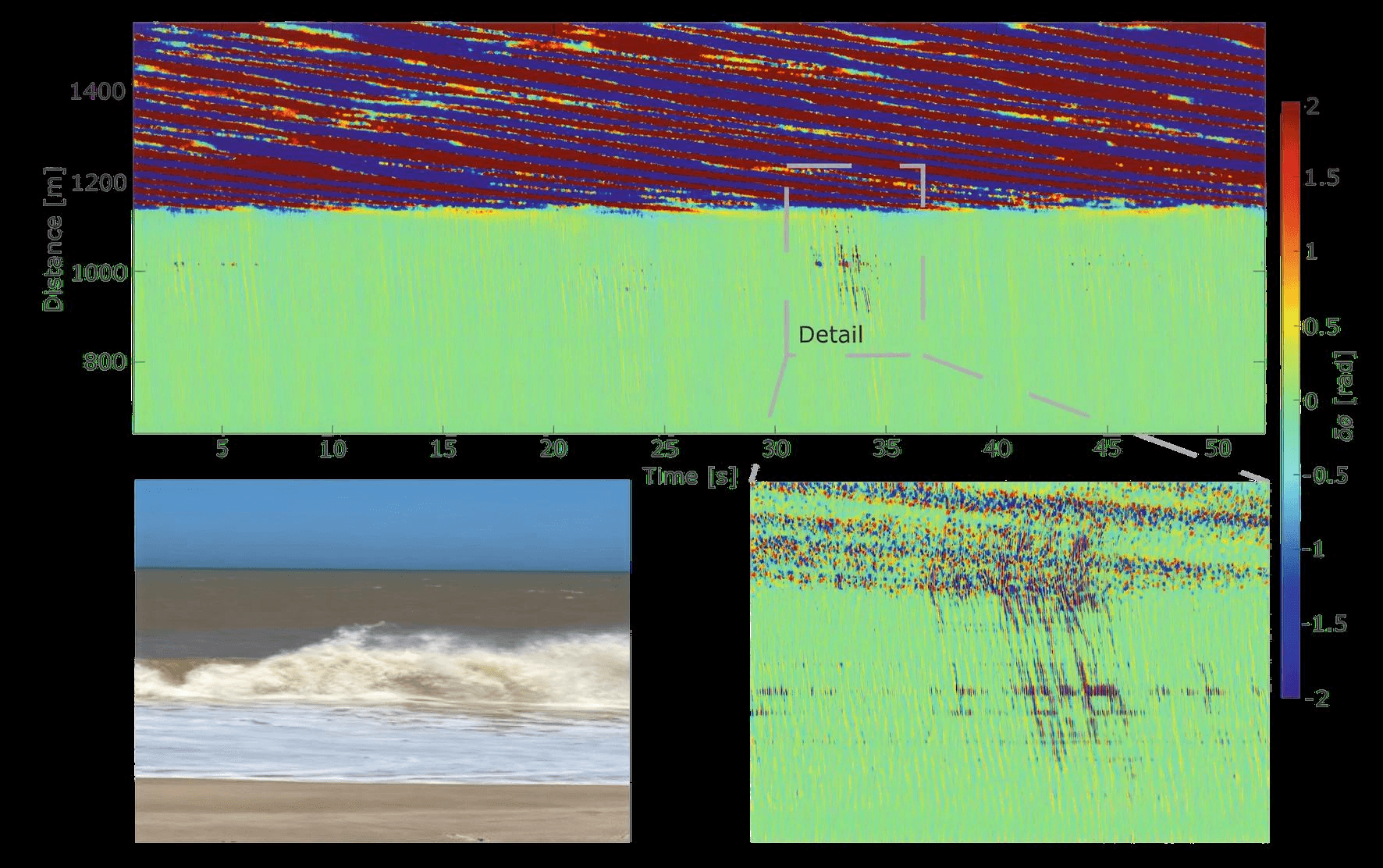
This characteristic is central to the value of the solution — the specificity of the detection lies in the software, not the hardware, which makes it possible to calibrate the same physical system for different monitoring purposes.
The results should contribute directly to the scientific understanding of cetacean migration patterns along the Brazilian coast. Species such as the humpback whale use the corridor between the South Atlantic and the north-eastern coast during the breeding season, and continuous data like that generated by the DAS system will help Instituto Aqualie refine population estimates and identify which species pass through different stretches of the coast over the year — essential information for planning seismic campaigns with lower environmental impact.
The partnership between Immer Messen, Instituto Aqualie and Petrobras is still developing, with the goal of expanding the geographic coverage of the monitoring and improving automatic species classification models over the coming years.
The project is recognised as the first DAS whale monitoring carried out in the South Atlantic
This establishes Immer Messen as a reference in distributed acoustic monitoring solutions for offshore environments — a capability that extends, on the same technological base, to applications such as subsea asset security, intrusion detection on pipelines and cables, and structural monitoring of critical infrastructure.
The results described in this case are documented in a peer-reviewed, open-access book chapter:
ANDRIOLO, A.; MARCON, E. H.; DE CASTRO, F. R.; RODRIGUES, G. M.; MIRANDA, G. A.; VIANA, Y.; GOLODNE, P. M.; POEYS, R. A. C.; SILVA, A. A. C.; AMORIM, T. O. S.; DJOKIC, D.; PIZZORNO, J. L. A. Permanent Reservoir Monitoring (PRM) and Distributed Acoustic Sensing (DAS) as Advanced Technologies for Maximizing the Acquisition of Acoustic Environmental Information. In: POPPER, A. N. et al. (eds.). The Effects of Noise on Aquatic Life IV. Cham: Springer, 2026. DOI: 10.1007/978-3-031-94229-7_225-1.
If you would like to know more about our solutions, leave us your contact.