Intelligent Pipeline Monitoring with Optical Fibre

Real-Time Anomaly Detection

General information

Client: Natural Gas Transmission / Brazil
Date: July 2026
Duration: 3 weeks
Tags: DFOS, Optical Fibre, Pipeline Monitoring, Anomaly Detection, Artificial Intelligence, Machine Learning, Pipeline Security, Pipelines, Real-Time Monitoring, Oil & Gas

The challenge

Large natural gas transmission operators face a permanent challenge: monitoring long pipeline sections in remote, often hard-to-reach areas against threats ranging from intrusion and vandalism to unintentional interference from machinery and vehicles near the right of way — or, in the most critical scenario, deliberate attempts to drill into the pipeline.

Conventional monitoring methods — foot patrols, fixed cameras and periodic inspections — offer neither continuous coverage nor immediate response. The time between event and detection can be fatal to the integrity of the system and to the safety of surrounding communities.

The solution

Maximum precision without complex infrastructure

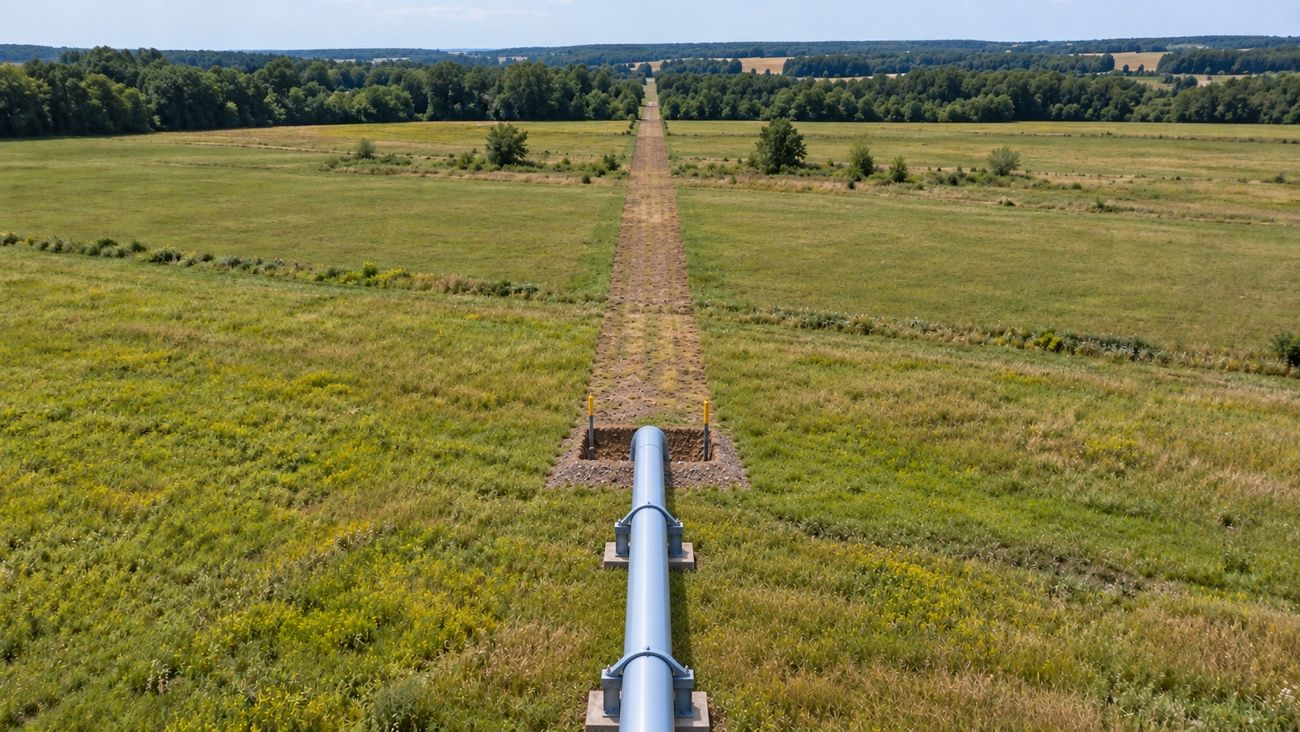
A major Brazilian natural gas transmission company contracted Immer Messen for a project of continuous, autonomous monitoring of a pipeline section using DFOS — Distributed Fibre Optic Sensing — technology combined with Artificial Intelligence.

Using an ordinary telecom optical fibre cable installed along the pipeline, the Immer Messen DATS system turned the fibre into a dense array of distributed acoustic sensors, able to detect any disturbance along the entire monitored length — with no additional equipment in the field, no continuous human intervention and no complex infrastructure works.

How it works

The DATS optical interrogator sends light pulses along the fibre and analyses the reflected signals with a spatial resolution of 3 metres. Any acoustic event or mechanical vibration along the pipeline — a human footstep, a passing vehicle or the vibration of an excavator — alters the signal pattern in a characteristic way. The Immer Messen AI algorithms process these variations in real time and automatically classify every detected event.

The operator follows everything remotely, from a control room more than 200 km away from the monitored section.

Over weeks of autonomous, continuous operation, the DATS system performed strongly across every scenario tested. Blind simulated events were staged along the monitored section, with the operations team unaware of the type, location or timing of each occurrence. The system detects the anomalies and classifies them into the following event classes:

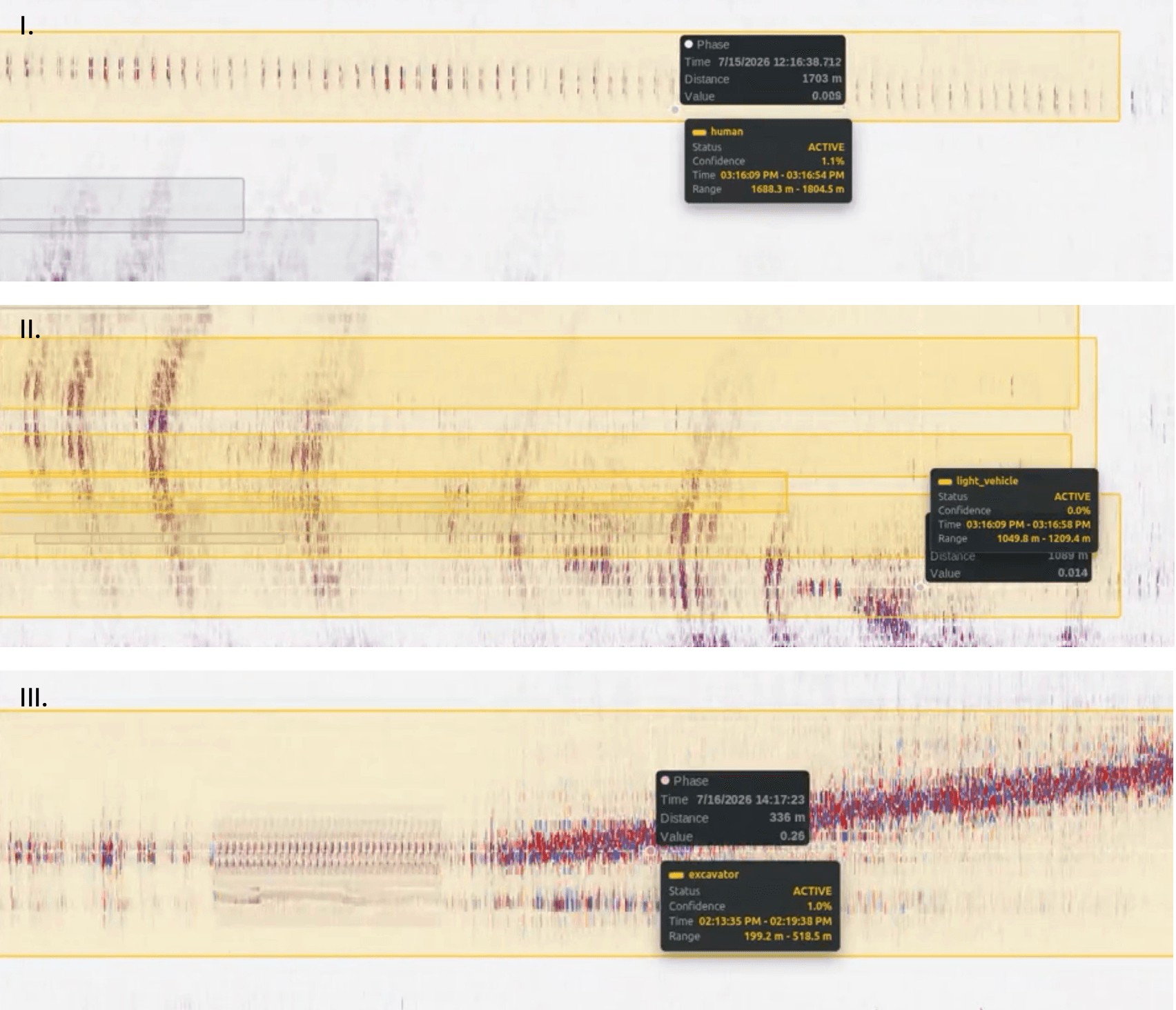
  • Person walking along the right of way (signal example I.)
  • Motorcycle
  • Light vehicle (signal example II.)
  • Heavy vehicle
  • Excavator in operation (signal example III.)
  • Pipeline drilling
  • Animals (cattle moving in the adjacent pasture)

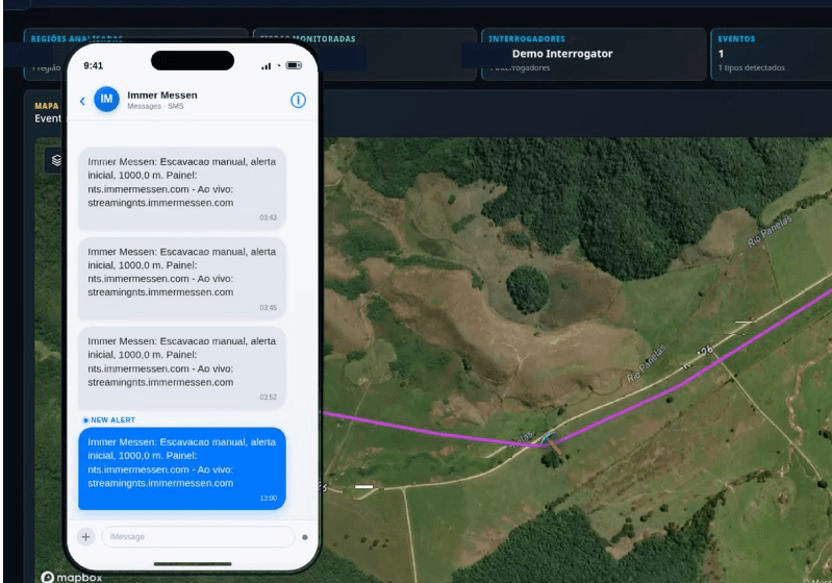
Every alert was triggered and sent by SMS to the operations team in under 1 minute after the event — with no local supervision whatsoever.

Some samples of detection signals and automatic classification are shown below.

I. Person walking along the right of way: explicit signals reveal the footsteps and the movement of the person in the vicinity of the optical cable;

II. Light vehicle: more intense mechanical patterns spreading through space-time, whose apexes reveal spatial displacement at higher speed and under varying intensities — associated with the uneven terrain of the region;

III. Excavator: the signal shows three types of pattern that reveal distinct stages of operation. At the start, the signals are associated with actual digging, the periodic action creating intense mechanical patterns that spread through space. In the second stage there is steady behaviour with dominant higher-frequency patterns, associated only with the excavator switched on but stationary. In the third stage, more intense mechanical signals with spatial-temporal displacement reveal the excavator moving.

Three stacked DAS records labelled I, II and III, each with the detection window highlighted and the class assigned by the algorithm: person, light vehicle and excavator.
Image I: automatic identification of human footsteps around the monitored asset Image II: automatic identification of a light vehicle travelling near the monitored asset Image III: automatic identification of an excavator operating near the monitored asset

Technical differentiators

  • Continuous 24/7 monitoring, with no supervision in the field
  • Automatic AI event classification — not just detection, but identification of the type of threat
  • Real-time SMS alerts in under 1 minute
  • Remote monitoring from a control room hundreds of kilometres from the monitored point
  • Operation over ordinary telecom optical fibre — with no additional point sensors
  • Spatial resolution of 3 metres along the entire monitored section
System event dashboard over a satellite view of the monitored section, with the pipeline route highlighted, and a phone in the foreground showing the sequence of digging alerts received by SMS.
Example of an SMS alert sent to the client after digging was identified along the monitored section

Conclusion: DFOS technology and AI raise pipeline security to a new level

The project showed that Immer Messen DFOS technology, combined with proprietary AI algorithms, can turn the optical fibre already available in pipeline infrastructure into a robust, autonomous and precise security monitoring system — giving the operator real-time visibility that conventional methods simply do not offer.

Talk to our team

If you would like to know more about our solutions, leave us your contact.